Bergen is Norway's second largest city. It was the home of medieval kings. But it was also a trading post for the Hanseatic League. Indeed, Bryggen is a vestige of that era. It's a photogenic quayside district of brightly-coloured wooden houses with triangular gables.
The backdrop to the city of Bergen is an arc of seven mountains. For much of the year, snow covers the peaks. In addition, the mountains of Fløyen and Ulriken have a funicular or cable car. They are waiting to take you up to the summit. From there, you can walk along rocky paths with an intoxicating view of Bergen and its fjords.
In fact, Hardangerfjord overlooks a landscape that doesn't seem real until you're there. It makes a great destination for a day trip from Bergen. Fearsome rock faces surround the fjord and make it surreal.
Let's explore the best things to do in Bergen:
1. Bryggen
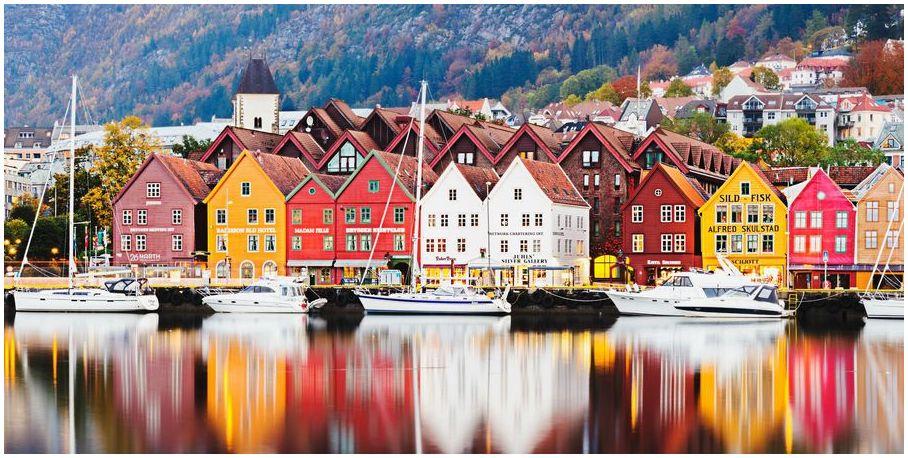
The row of slim wooden houses in yellow, ochre and red on the quayside is unbeatable. On Vågen Bay, these houses make one of Bergen's most famous images.
Bryggen is also a UNESCO World Heritage Site. In fact, these buildings would once have been warehouses, European grain stores and fish stocks.
The passages between the shop fronts suggest what Bergen might have looked like in medieval times.
The city grew up around this riverside community almost a thousand years ago. In the mid-14th century, Bryggen became a "Kontor". This word means an outpost of the Hanseatic League. Indeed, this concept was present throughout Northern Europe at the time.
2. Hanseatic Museum and Schøtstuene

Following the fire at the beginning of the 18th century, this museum opened its doors. The beautiful building is made of wood. It houses the Hanseatic Museum. It is also one of the oldest wooden buildings in Bergen.
Since 1872, there has been a museum documenting some 400 years of the German Merchants' Guild's association with Bergen from around 1350 to 1750. It is the only building in Bryggen to have retained its original interiors.
Its occupants were forbidden to light fires for light, heat or food because of the risk of fire. During the day, they worked downstairs in the warehouse and offices and spent the night in dormitories.
On the same ticket, you can go inside Schøtstuene, a short walk to the back of Bryggen, the meeting rooms of the Hanseatic League, with meeting rooms, banqueting halls and courtrooms.
3 St. Mary's Church

Bergen's oldest building is located near the Schøtstuene behind Bryggen. It is an unusual example of Romanesque architecture in Norway. In fact, no other church in Norway has a western façade like this one. With square, unadorned towers and round-headed windows typical of the Romanesque style.
St Mary's Church dates from the middle of the 12th century.
The pointed windows in the choir are Gothic and suggest that this part of the church was built following a fire in 1248. On the south portal, you can see Roman-style bestial and foliate motifs on the capitals of the jambs.
The church's greatest treasure is its altarpiece. Its sculpture dates back to the 15th century in the Hanseatic capital of Lübeck. The triptych shows the Virgin and Child in the centre, flanked by St Olav and St Antony on the right and St Catharine and St Dorothy on the left.
4. Fløyen and the Fløibanen funicular railway

This is just 150 metres from Bryggen. You can catch the funicular. This will take you to the top of Fløyen mountain. Fløyen is 425 metres high. What's more, the funicular will get you there in no time.
The first trip up Fløibanen was in 1918. It is Bergen's most popular attraction. The track is 850 metres long and the train takes you over 300 metres in just six minutes.
When you arrive, you can stop at the Fløytrappene and admire the view of Bergen, the fjords and the shipping traffic heading out to the North Sea. This can be the first stop on a walk along this balcony over the city. A restaurant and children's play area climb the wide staircase.
5. Troldhaugen, home of Edvard Grieg

Edvard Grieg is Norway's pre-eminent composer. He spent the last 20 years of his life in this picturesque villa. It stands on a hilltop overlooking Lake Nordås.
The villa is called Troldhauden (Troll Hill). It was designed by Grieg's cousin Schak Bull. Grieg spent summers here with his wife when he was at home in Norway, composing rooms in a small hut overlooking the lake.
In 1985, the Troldsalen auditorium was built. It's a discreet space that can seat 200 people. A decade later, a museum building was added. It features an exhibition on Grieg's life and music.
In the meantime, the house is an intimate living museum. It is filled with the Griegs' personal effects. In particular a Steinway grand piano that Edvard received as a birthday present in 1892.
6. KODE art museums

In 2013, a group of four art institutions and cultural sites around Bergen came together. They gave birth to "KODE". A museum complex that can be visited with a single ticket.
KODE 1 is the museum of crafts and design. It has a permanent display of gold and silver objects produced in Bergen. As well as paintings by old masters and European and Asian antiques.
KODE 2 is a museum of contemporary art, which at the time presented an exhibition for the Japanese artist Chiharu Shiota.
KODE 3 presents works from the golden age of Norwegian art. These include paintings by Edvard Munch and the Romantic artist Johan Christian Dahl.
Finally, KODE 4 is an art museum that also exhibits works by Dahl, Paul Klee, Picasso and Asger Jorn.
Children are very welcome at KODE 4, which houses the Kunstlab. Here children can discover art through play.
7. Mount Ulriken

The highest of Bergen's seven mountains rises to 643 metres. Like Fløyen, it's easy to get to the top.
In the case of Ulriken, it's the Ulriksbanen aerial tramway, which has been taking people to the summit since 1961. At the top, there is another exhilarating viewpoint with telescopes, as well as a restaurant and a TV tower visible across Bergen.
If you prefer a challenge, you can take a hike along a system of trails. The most popular route starts at Montana, accessible by no.
12 bus and takes around 90 minutes in good weather.
After reaching the summit, experienced hikers can continue their adventure on the Vidden trail to Fløyen.
8. Hardangerfjord

In Bergen, you're close enough to Norway's second-longest fjord that a trip is a no-brainer.
You'll need at least a day to feel like you've got it all right, and luckily the infrastructure is solid, with buses, ferries and travel agents looking to give you the best experience of an ethereally beautiful landscape.
Hardangerfjord is also Norway's fruit orchard, for at the water's edge, at the base of imposing rock walls, are lush apple orchards and strawberry farms.
In season, you can buy apples using the honour system and visit villages where folk culture is still intact (embroidery, traditional fiddles). You may also want to see nature in its raw state and chart an almost inconceivable course, such as the iconic overhang of Trolltunga (Troll's Tongue) or the Folgefunna glacier.
9. Bergenhus Fortress

In one form or another, this fortress has guarded the opening to Vågen Bay since the mid-thirteenth century.
This large complex dates back to the nineteenth century and houses buildings dating from all periods between the twelfth and twentieth centuries (German bunkers from the Second World War). One of the oldest is the magnificent Haakon's Hall, a ceremonial hall built in the mid-13th century during the reign of King Haakon IV of Norway and used for the wedding of his son Magnus VI of Norway to Ingeborg of Denmark.
The walls feature Romanesque and Gothic window openings, while a horn gable caps the façade.
Amateur historians should take a self-guided tour of the fortress enclosure and discover the German bunker, the guards' and commander's quarters, the stables, the batteries and the Koengen, a former depot now used for high-profile open-air concerts in summer.
10. Rosenkrantz Tower

In the Bay of Vågen, to the south of the Bergenhus fortress, lies another structure of great historical value.
The Rosenkrantz Tower is named after the nobleman and governor Erik Rosenkrantz, who oversaw the remodelling of the tower into one of Norway's principal residences in the 16th century.
The tower had been in existence since the late 13th century, when King Eric II of Norway, the last king to sit at the Bergen court, took up residence here.
The Rosenkrantz Tower had a truly high-low configuration, with the king and later the governor's residence on the top floor, while the basement was a dungeon, a role it occupied until the 19th century.
In the 1740s, the upper floors of the tower became a gunpowder magazine and remained so until the 1930s.
Visitors now climb the dark, narrow staircase to view Vågen Bay from the roof.
11. Fantoft Stave Church

You can take the tram from Bergen to this rebuilt stave church a few kilometres south of the city centre.
The Fantoft Stave church originates from the village of Fortun in the district of Sogn. Built around 1150, it was moved here in pieces in 1883 to save it from demolition.
Unfortunately, in 1992, the church was burnt down in a fire, but it was painstakingly rebuilt over the next five years.
The rebuilt church is a sight to behold; even a small part of the original monument could be saved, with the exception of the gold cross on the altar, a relic on a wall and a historic stone cross brought from the municipality of Sola.
12. Damsgård Manor

On the other side of Damsgårdssundet (Damsgård Sound) stands what could be the world's most beautiful rococo wooden mansion.
The Damsgård mansion was built in the 1770s for the Minister of War Joachim Christian Geelmuyden Gyldenkrantz, at a time when aristocratic country retreats were springing up on the outskirts of the city.
In summer, the grounds are open to the public. They include a Lord's Garden and a Lady's Garden. These are both formal and enriched with statues, topiary and geometric flowerbeds.
There is also a looser English garden with undulating lawns and a pond.
As for the house, the decor has been restored to its eighteenth-century splendour and can be seen on guided tours at noon and 2pm, and at 1pm on Sundays.
13. VilVite Science Centre

If you're in Bergen with little ones and time doesn't permit, the VilVite Science Centre is synonymous with fun and education.
The centre has 75 stations inviting children to learn by taking part in games and interactive experiments.
Children can become TV hosts to give weather forecasts, steer a container ship, drill for oil and go upside down on the "G-Force", a bike on a track that makes a complete loop.
Almost all the stations focus on energy, the ocean and the weather.
At weekends and during school holidays, there are also 3D film screenings and specially organised science programmes.
14. Bryggens Museum

This museum in Bryggen owes its existence to a calamity.
In 1955, the district was hit by a fire, but this gave the town a chance to carry out archaeological digs.
The discoveries made during these excavations opened a window onto medieval life and trade in Bryggen.
They are at the heart of the museum, which has been built around the 900-year-old foundations that were discovered.
In the display cabinets are medieval weights, jewellery and a wealth of runic inscriptions carved into the wood.
15. Fish market

On the innermost quay in Vågen Bay, fishermen have been selling their catch since the 13th century.
And although today's fish market is more tourist-oriented, it's still something to see when you visit Bergen.
There are open-air stalls alongside a new covered hall, which is more of a culinary destination than a traditional market.
Inside, you can enjoy freshly shucked oysters with a glass of Riesling, heat up a fish soup, mango and salmon roll or fried squid, or enjoy a delicious and expensive meal.
The open-air market's opening hours shrink in winter. So it only opens at weekends. But in summer, you have to pop in from one day to the next to marvel at all the creatures from the North Sea.